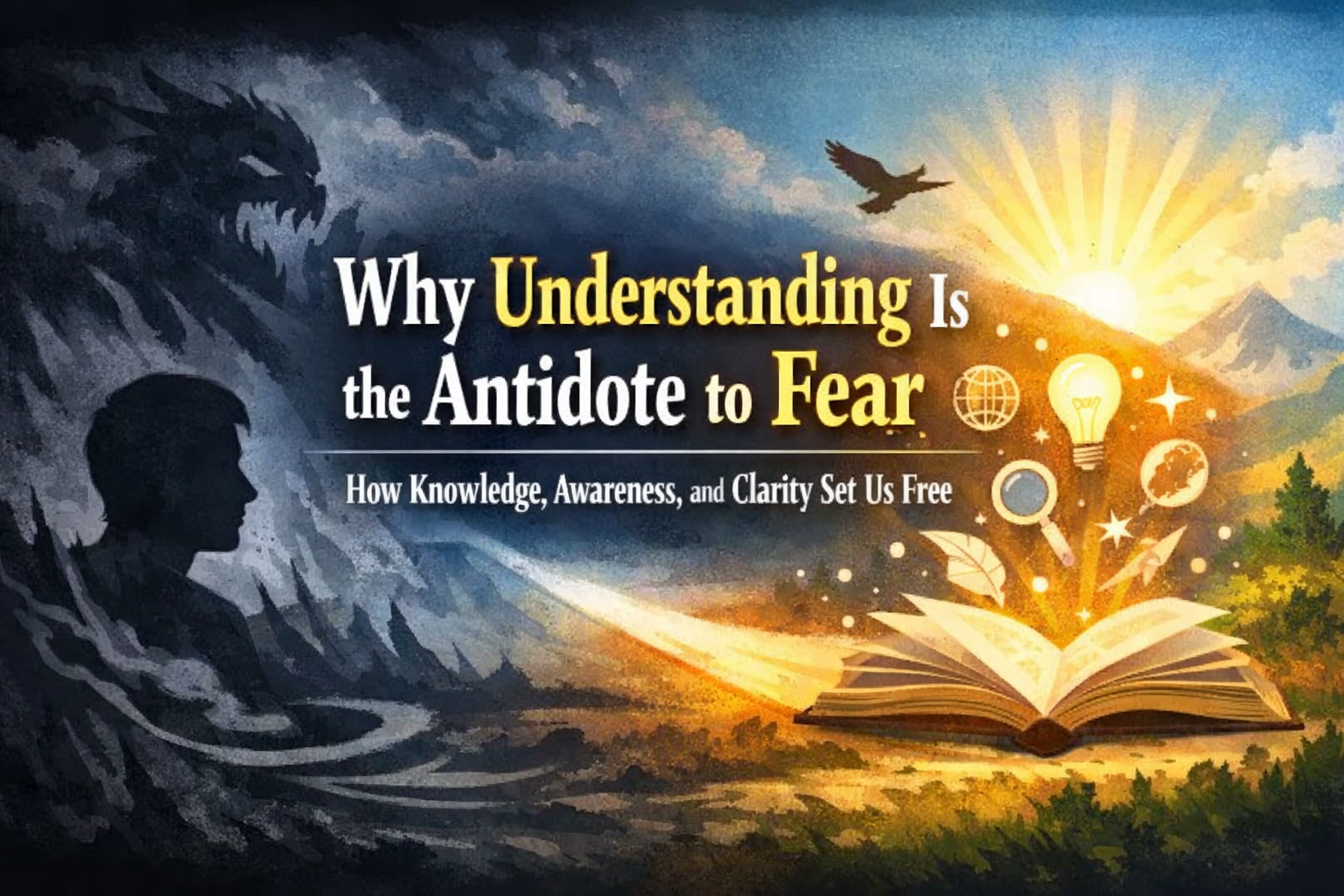
Why Understanding Is the Antidote to Fear : How Knowledge, Awareness, and Clarity Set Us Free

Introduction: Fear Is Powerful—but Not Invincible
Fear is one of the most primitive emotions we experience. It lives deep inside our nervous system, designed to protect us from danger. Yet, in modern life, fear often goes far beyond physical threats. We fear failure, rejection, judgment, uncertainty, change, illness, loss, and even happiness itself.
What makes fear so overwhelming is not always the danger—but the unknown.
This is where understanding becomes revolutionary.
When we understand what we fear, why we fear it, and how it actually works, fear begins to lose its authority over us. It doesn’t vanish overnight, but it softens. It becomes manageable. And eventually, it transforms.
This blog explores why understanding is the antidote to fear, how fear thrives on ignorance, and how clarity, knowledge, and self-awareness can help us reclaim control of our minds and lives.
Fear and the Unknown: Where It All Begins
Most fears are born not from reality, but from imagination.
- Fear of public speaking often isn’t about speaking—it’s about imagined judgment.
- Fear of failure isn’t about failing—it’s about what we think failure means.
- Fear of change isn’t about change—it’s about uncertainty.
The human mind hates uncertainty. When it doesn’t have facts, it fills gaps with worst-case scenarios. This mental storytelling creates fear that feels real—even when the threat is not.
Understanding interrupts this cycle. When we replace assumptions with facts, fear starts shrinking.
The Psychology Behind Fear 🧠
From a psychological perspective, fear activates the amygdala, the brain’s alarm system. Its job is to detect danger quickly and keep us safe. But the amygdala does not distinguish well between real threats and imagined ones.
That’s why:
- An email from your boss can trigger anxiety.
- A small health symptom can feel like a serious illness.
- Silence from someone can feel like rejection.
Understanding engages the prefrontal cortex—the rational, thinking part of the brain. When we understand a situation, logic steps in and calms the alarm.
In simple terms: Fear reacts. Understanding responds.
Real-Life Example
1: Fear of Failure
Many people stay stuck in unhappy jobs, unfulfilling relationships, or stagnant lives because they fear failure. But what happens when we truly understand failure?
Failure is:
- Feedback, not a verdict
- A lesson, not a label
- Temporary, not permanent
People who study successful entrepreneurs, artists, or athletes quickly realize that failure is not the opposite of success—it is part of it.
When understanding replaces fear, people stop asking:
“What if I fail?”
And start asking:
“What will I learn if I do?”
That shift alone changes lives.
2: Fear in Relationships
Fear shows up quietly in relationships:
- Fear of abandonment
- Fear of being misunderstood
- Fear of expressing needs
- Fear of conflict
Often, people don’t fear the other person—they fear the emotions they don’t understand.
When someone understands:
- Their attachment style
- Their emotional triggers
- Their communication patterns
They stop personalizing everything. Arguments feel less threatening. Silence feels less scary. Boundaries feel less guilty.
Understanding turns emotional chaos into emotional clarity.
3: Fear of Health and the Body
Health anxiety is one of the most common modern fears. A headache becomes a tumor. Fatigue becomes a serious disease. Google searches amplify panic.
But when people learn:
- How the body responds to stress
- How common certain symptoms are
- How anxiety mimics physical illness
Fear reduces dramatically.
Doctors often say: “Half of healing is education.”
Understanding the body builds trust with it. And trust dissolves fear.
4: Fear of the Future
The future is unknown by nature. That’s why it’s fertile ground for fear.
People fear:
- Financial instability
- Career uncertainty
- Parenting mistakes
- Aging
- Loss
But the future becomes terrifying only when we imagine it without context.
Understanding teaches us that:
- Life is unpredictable for everyone
- Control is limited, but preparation is possible
- Growth happens through uncertainty
When we understand that uncertainty is not danger—but life itself—fear loosens its grip.
How Media and Society Feed Fear
Fear is profitable.
News headlines, social media, and even casual conversations often exaggerate danger. Fear keeps people alert, addicted, and reactive.
But understanding teaches media literacy:
- Not every headline equals truth
- Not every viral story equals reality
- Not every opinion equals fact
People who seek understanding instead of outrage become calmer, wiser, and harder to manipulate.
Parenting and Fear: A Generational Cycle
Parents often pass fear unknowingly to children:
- “Don’t do that, it’s dangerous.”
- “What will people say?”
- “Better be safe than sorry.”
While protection is necessary, fear-based parenting limits confidence.
Parents who understand child psychology raise children who:
- Take healthy risks
- Trust themselves
- Handle failure better
Understanding breaks generational fear cycles.
Fear vs Awareness: A Crucial Difference
Fear says:
- “Something bad will happen.”
- “You can’t handle this.”
- “Stay small. Stay safe.”
Awareness says:
- “There is a risk.”
- “You can prepare.”
- “You will learn.”
Understanding turns fear into awareness.
Fear paralyzes. Awareness empowers.
Why Avoidance Strengthens Fear
Avoidance feels like relief, but it feeds fear.
- Avoiding difficult conversations increases anxiety.
- Avoiding challenges reduces confidence.
- Avoiding emotions intensifies them.
Understanding teaches that fear weakens when faced with clarity and compassion.
That’s why therapy, journaling, self-reflection, and learning are powerful—they create understanding.
Practical Ways to Use Understanding to Reduce Fear
1. Ask Better Questions
Instead of “What if everything goes wrong?” ask:
- What is most likely to happen?
- What evidence do I have?
- How have I handled similar situations before?
2. Educate Yourself
Fear loves ignorance. Learn about:
- Your emotions
- Your body
- Your challenges
- Your goals
Knowledge builds confidence.
3. Name the Fear
Unidentified fear feels bigger. Naming it gives shape and limits.
“I’m not scared of change. I’m scared of losing stability.”
4. Separate Feelings from Facts
Feelings feel real—but they are not always factual.
Understanding helps you say: “I feel afraid, but I am not unsafe.”
5. Practice Self-Compassion
Understanding yourself means accepting fear without judgment.
Fear doesn’t mean weakness. It means you’re human.
Spiritual Perspective: Understanding as Inner Light
Across philosophies and spiritual teachings, understanding is often described as light, while fear is described as darkness.
Darkness disappears not by fighting it—but by bringing light.
Understanding illuminates:
- Our wounds
- Our patterns
- Our purpose
And in that light, fear naturally fades.
When Fear Still Exists—and That’s Okay
Understanding doesn’t eliminate fear completely. It transforms your relationship with it.
Courage is not the absence of fear—it is the presence of understanding.
You may still feel afraid before:
- Big decisions
- Important conversations
- Life transitions
But fear no longer controls you. You walk forward with awareness instead of panic.
Conclusion: Understanding Is Freedom
Fear thrives where understanding is absent. It grows in silence, ignorance, and assumptions. But the moment we seek clarity—through learning, reflection, conversation, or experience—fear begins to dissolve.
Understanding gives us:
- Emotional resilience
- Mental clarity
- Inner peace
- Personal power
The more we understand life, ourselves, and others, the less there is to fear.
Because what is understood no longer needs to be feared—it needs to be faced, accepted, and lived through.