From Cowrie Shells to Digital Rupees: The Evolution of Indian Coins Through Time

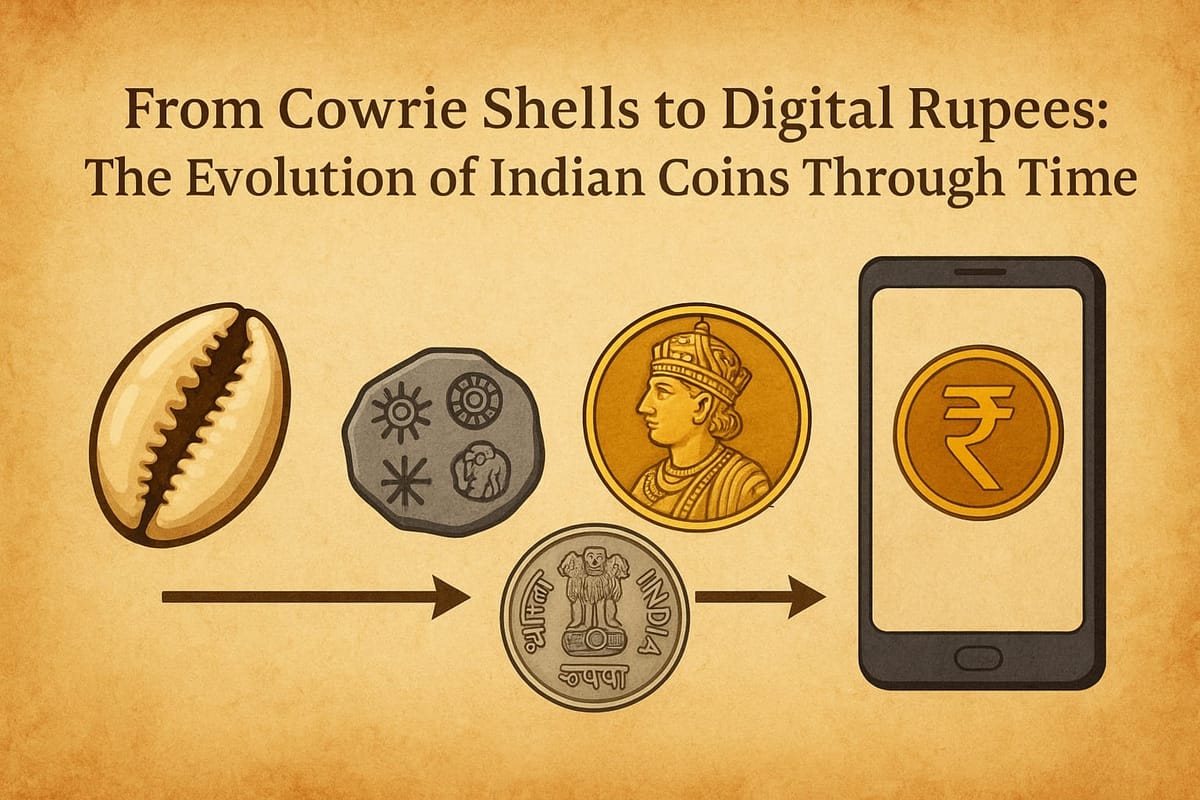
A Journey of India’s Identity, Power & Progress.
- Where Money is more than metal.
- It is memory.
- It is culture.
It is the silent storyteller of a civilization's rise, struggle, power, and transformation.
India, one of the world’s oldest continuous civilizations, carries a rich history of currency that stretches back over 3,000 years. The journey of Indian coins — from shells and punch-marked silver pieces to modern steel rupees and digital currency — reflects a story of trade, empire-building, cultural shifts, and technological evolution.
This blog takes you through a fascinating, emotional, and realistic journey of how Indian coins upgraded over time — how every change in shape, metal, symbol, and value carries a story of India itself.
1. Before Coins: When Money Was Not Metal
Before metal coins existed, India used what the world calls primitive or commodity money:
- Cowrie shells
- Grains
- Copper beads
- Pieces of cloth
- Barter trades (item-for-item)
Cowrie shells traveled from the Maldives to the Indian shores and became widely accepted currency long before kings minted coins. Even today, Indian languages carry traces of this past — in some villages, older people still say “kaudi” as a word for money.
This era shows something powerful:
India was trading long before coins existed.
2. The Birth of Coins: Punch-Marked Silver Pieces (600–300 BCE)
Around 600 BCE, during the Mahajanapada period, India did something revolutionary — it created one of the world’s earliest coins.
These were called Punch-Marked Coins (PMCs).
Features
- Made of silver or copper
- No king’s face
- Shapes were irregular, as if someone cut metal sheets by hand
- Symbols were punched using dies — sun, animals, trees, hills, wheel patterns
These coins were used during the times of:
- Magadha
- Saurashtra
- Kashi
- Kuru
- And other ancient kingdoms
The punch-marked coin was not just an upgrade in currency — it was an upgrade in trust.
For the first time, buyers and sellers had a standard, reliable medium of exchange.
3. Mauryan Brilliance: State-Controlled Coinage (322–185 BCE)
Under Chandragupta Maurya and Ashoka, India saw a major leap in currency development.
The Mauryan Empire established centralised state control over minting — a concept similar to modern RBI control.
Why this mattered
- Standard weight → less cheating in trade
- Uniform symbols → easier recognition
- Empire-wide acceptance → smoother commerce
Coins now symbolised power and authority. They became a mark of the state’s identity.
4. Indo-Greek and Kushan Era: The Human Face Appears (200 BCE–300 CE)
A massive upgrade happened under the Indo-Greeks and later the Kushans.
For the first time in India’s history:
- Human faces appeared on coins
- Legends were written in Greek, Kharosthi, Brahmi
Kushan emperor Kanishka’s coins showed:
- His image
- Depictions of Indian and foreign deities
- Highly artistic designs
This period marks the beginning of portrait coinage, showing the influence of cross-cultural trade and the arrival of foreign powers.
5. The Gupta Age: The Golden Standard (320–550 CE)
The Gupta Empire is often called the Golden Age of Indian Coins — literally and symbolically.
Gupta coins were special because:
- Made mostly of pure gold
- Featured kings in various poses — hunting, archery, playing veena
- Featured goddess Lakshmi and other deities
- High-quality art, precision, and craftsmanship
These coins showed India’s wealth, prosperity, and artistic maturity.
6. Medieval India: Rajputs, Cholas & Islamic Sultanates (600–1526 CE)
As political boundaries changed, coins evolved too.
Rajput & Chola Coins
- Depicted temples, animals, and dynastic symbols
- Featured Sanskrit inscriptions
Delhi Sultanate Coins
A major upgrade came with:
- Arabic inscriptions
- Replacement of images with calligraphy (as Islam discourages depictions)
- Introduction of Tanka (silver) and Jittal (copper) coins
Coins now reflected new rulers, new religions, and new cultural influences.
7. The Mughal Mastery: Coins Become Art (1526–1857)
Mughal emperors took coinage to new artistic heights.
Salient features:
- Beautiful Persian calligraphy
- High-quality gold, silver, and copper coins
- Zodiac coins by Jahangir (highly collectible today)
- Timeless elegance in design
Mughal coins showed India’s global trade power — they were accepted even outside the subcontinent.
8. The British Era: From Rupee to Standardized Modern Coinage (1858–1947)
The British brought the biggest transformation in India’s monetary system.
Major Upgrades
- Introduction of the Modern Rupee
- Standardization of :
- Size
- Weight
- Metal
- Denominations
- Introduction of coins featuring:
- Queen Victoria
- King Edward VII
- King George V & VI
- Metals used
- Silver (early British period)
- Nickel
- Bronze
- Copper-nickel
The rupee became more industrial, mechanical, and uniform.
However, it also reflected India’s loss of economic freedom under colonial rule.
9. Independent India (Post-1947): The Rupee Finds Its Identity Again
When India became independent, the first big change was removing the British monarch’s portrait.
First coins of independent India (1950)
- Emblem of Ashoka’s Lion Capital
- Denominations in naya paisa
- More Indian-themed symbols
India was rebuilding, and coins became a symbol of national pride.
10. Decimalisation in 1957: A Modern Monetary Upgrade
Before 1957, India followed:
- 1 rupee = 16 annas
- 1 anna = 4 paisa
Confusing, right?
So India adopted a simple decimal system:
- 1 rupee = 100 paisa
This was one of the biggest upgrades to modern currency.
11. Changing Metals: From Pure Metals to Alloys
As metal prices changed, India shifted materials:
1960s: Nickel and copper
1980s: Stainless steel introduced
1990s–2000s: Nickel-brass, ferritic stainless steel
Modern coins became:
- Lighter
- Cheaper to mint
- Better for mass usage
12. The New Millennium: Contemporary Indian Coins (2000–2025)
The last two decades brought major upgrades:
Denominations
- ₹1, ₹2, ₹5 become common
- ₹10 bimetallic coins introduced
- ₹20 coin launched in 2020 (India’s first 12-sided coin)
Design Themes
Coins now celebrate:
- Agriculture
- Children
- Literacy
- Technology
- National events
Security Features
- Unique edges
- Bi-metallic designs
- Micro-lettering
These changes ensured both practicality and authenticity.
13. Special Commemorative Coins
India issues beautiful commemorative coins honouring:
- Mahatma Gandhi
- Jawaharlal Nehru
- Rabindranath Tagore
- ISRO achievements
- International events
These coins are collectors’ favorites and carry great emotional value.
14. Digital Currency and the Future: The New Era of the Rupee
We have moved from shells → metal → alloys → and now → digital currency.
Key Upgrades Today
- Digital Rupee (CBDC) launched by RBI
- QR-based transactions replacing small coins
- Coins still used, but digital money rising fast.
Just as cowries became outdated centuries ago, metal coins too may become symbolic one day.
15. What This Journey Really Shows
The evolution of Indian coins is not just about:
- metal changes
- shapes
- symbols
It is about India’s transformation.
Coins reflect:
- Our kings
- Our freedom struggle
- Our economic reforms
- Our cultural diversity
- Our technological progress
Every coin in our pocket carries the weight of thousands of years of history.
Conclusion: The Rupee Is Not Just Currency — It Is India’s Identity
From the first punch-marked pieces to modern ₹20 coins and digital rupees, India’s currency mirrors our journey as a civilization.
It tells us:
- Where we came from.
- What we endured and how far we’ve progressed.
- As times change, coins will continue to evolve.
But the story they carry — of resilience, diversity, and innovation — will stay timeless.