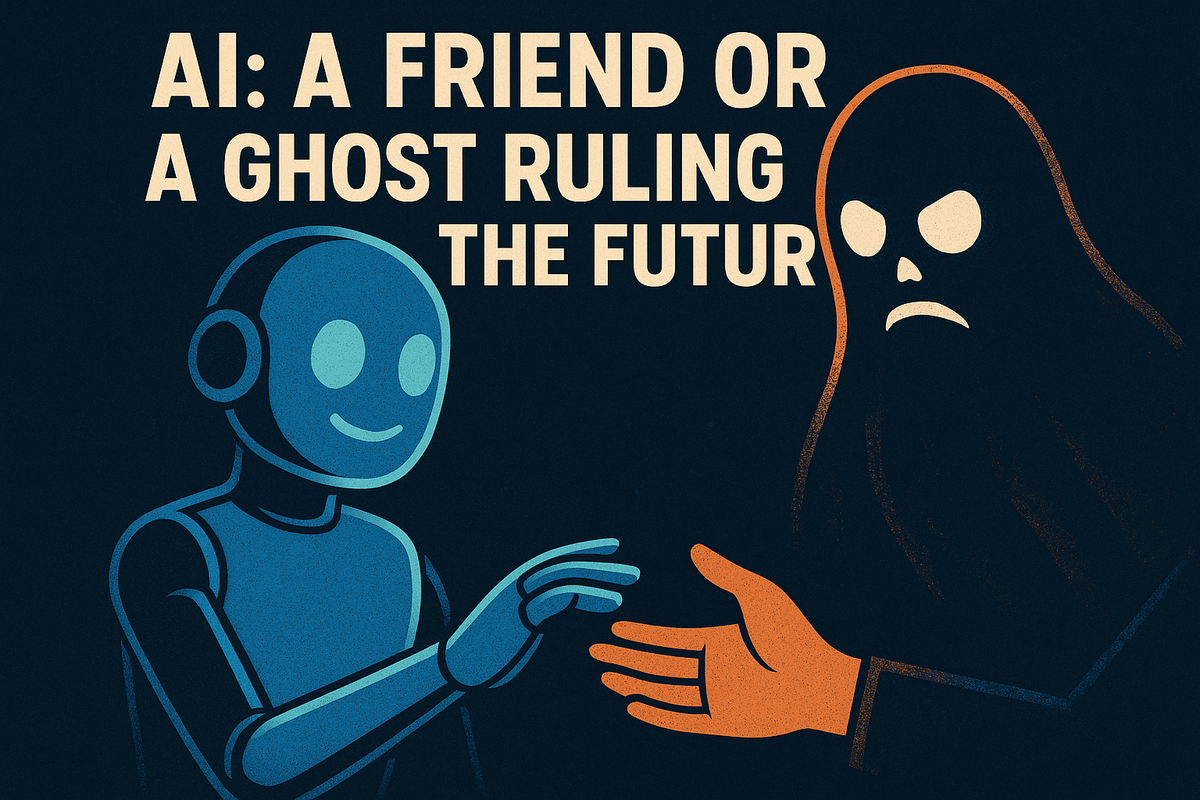
AI: A Friend or a Ghost Ruling the Future

Technology is a useful servant but a dangerous master." — Christian Lous Lange
In the last decade, Artificial Intelligence (AI) has gone from a futuristic buzzword to an invisible companion in our daily lives. It writes our emails, recommends our music, edits our photos, and even completes our sentences. But as this invisible force grows stronger, a profound question emerges:
Is AI becoming our friend, or is it quietly transforming into a ghost — ruling our future in ways we barely understand?
This question isn’t about fear or fascination; it’s about balance. AI mirrors human intention. In the right hands, it can cure diseases, clean oceans, and create art. In the wrong hands, it can manipulate minds, replace authenticity, and erode trust.
Let’s explore this double-edged evolution — the AI that helps humanity rise, and the AI that could haunt it.
The Rise of AI: From Helper to Decision-Maker
The earliest AI systems were simple rule-based tools designed to assist humans — spell-checkers, search engines, and recommendation systems. But today, AI has evolved into something far more complex: a decision-maker.
From diagnosing medical conditions to predicting stock trends, AI now makes judgments that affect millions of lives. It’s embedded in everything — smartphones, banking, education, and even the justice system.
But this evolution brings both promise and peril. AI can analyze in seconds what humans would take years to process. Yet, when algorithms are trained on biased or incomplete data, their decisions can reinforce discrimination or misinformation.
So, the real debate isn’t about whether AI will rule the future — it’s about how it will rule, and who will control it.
AI as a Friend: The Bright Side of Artificial Intelligence
When guided by ethical design and human empathy, AI becomes one of humanity’s greatest allies. It empowers us to work smarter, learn faster, and express creativity without limits.
Let’s explore how AI is making life better today — and the tools that exemplify this “friendly” face of technology.
1. ChatGPT (OpenAI) — Your Thinking Partner
ChatGPT has become the go-to conversational AI for millions of users worldwide. It can brainstorm content, assist with research, generate code, and even simulate tutoring sessions.
Unlike search engines that bombard you with irrelevant links, ChatGPT delivers personalized, human-like responses that adapt to your intent. Students use it for learning; businesses use it for automation; creatives use it for ideation.
Why it’s a friend: It augments human intelligence instead of replacing it. It helps you think, not just search.
2. Canva Magic Studio — Creativity for Everyone
Once upon a time, design was a skill reserved for professionals. Then Canva changed everything. Its AI-driven “Magic Studio” enables anyone to create stunning graphics, social media posts, or presentations in minutes.
Features like “Magic Edit” (for instant photo manipulation) and “Magic Write” (for text generation) save hours of manual work.
Why it’s a friend: It democratizes creativity — empowering people with ideas but no design background to express themselves visually.
3. Notion AI — The Smart Productivity Assistant
Notion AI acts like your personal digital secretary. It can summarize meeting notes, generate task lists, and organize projects seamlessly. By blending automation with creativity, it allows you to focus on meaningful work rather than administrative clutter.
Why it’s a friend: It brings clarity and structure to a chaotic digital life.
4. GrammarlyGO — Mastering Communication
Beyond correcting grammar, GrammarlyGO helps you rewrite messages for tone, conciseness, and impact. Whether you’re writing an email, essay, or blog, it helps you sound more articulate and confident.
Why it’s a friend: It strengthens human communication rather than replacing it. It teaches you how to write better.
5. Perplexity AI — Smarter Search, Verified Answers
Unlike traditional search engines filled with ads, Perplexity AI focuses on truth and transparency. It provides sourced, evidence-based answers and links back to original content, reducing misinformation.
Why it’s a friend: It puts knowledge above profit and transparency above manipulation.
AI as a Ghost: The Dark Side of Automation
But not all AI tools wear a friendly face. Some operate in shadows — influencing decisions, manipulating emotions, or collecting private data without consent.
When AI loses its ethical compass, it turns from assistant to apparition — invisible yet powerful, efficient yet morally hollow.
Here are some examples of AI technologies and trends that warrant caution.
1. Deepfake Generators — The Art of Deception
Deepfakes use AI to generate hyper-realistic fake videos and voices. While they can be used creatively in film or satire, they’ve also been weaponized to spread misinformation, commit fraud, or manipulate public opinion.
Imagine a fake video of a political leader declaring war — or a synthetic voice authorizing a bank transfer. The potential harm is enormous.
Why it’s a ghost: It blurs the line between truth and illusion, eroding trust in what we see and hear.
2. AI Beauty Filters — When Perfection Becomes a Prison
Social media platforms like Instagram, TikTok, and Snapchat offer AI-powered filters that alter faces and bodies to fit “ideal” beauty standards.
While fun at first, overuse of these filters leads to distorted self-perception and unhealthy comparisons, especially among young users.
Why it’s a ghost: It replaces self-acceptance with algorithmic perfection — feeding insecurities instead of confidence.
3. Emotion-Simulating Chatbots — Artificial Intimacy
Some AI chatbots are designed to mimic emotional connection. Users form relationships with them, believing they’re communicating with a caring entity.
But behind that empathy is code — a system trained to respond in ways that keep users hooked. This can lead to emotional manipulation, especially when companies monetize loneliness.
Why it’s a ghost: It gives the illusion of companionship without the reality of care.
4. Surveillance AI — The Watchful Eye
Facial recognition and predictive policing systems are increasingly being deployed in cities and workplaces. While marketed as “security tools,” they often operate with little transparency and can lead to privacy violations or wrongful profiling.
Why it’s a ghost: It watches, learns, and judges — without accountability.
5. AI Trading Bots — The Mirage of Easy Profit
The internet is full of promises of AI bots that can make anyone rich through “smart trading.” But many such systems are unregulated, opaque, and built on risky algorithms that can drain savings overnight.
Why it’s a ghost: It preys on greed and trust, hiding behind the mystique of “smart” investing.
The Ethical Crossroads: Can Humanity Stay in Control?
The real challenge isn’t stopping AI — it’s steering it.
AI doesn’t have morality; it learns from data. And data, unfortunately, reflects human biases, inequalities, and flaws. When algorithms make decisions based on that, discrimination and misinformation can scale globally.
That’s why AI development must follow three guiding principles:
1. Transparency: Users should know how AI makes decisions and what data it uses.
2. Accountability: Companies must be held responsible for AI-driven outcomes, not hide behind “black box” systems.
3. Human Oversight: AI should assist human judgment, not replace it — especially in areas like justice, healthcare, and education.
In short, we must ensure AI remains a tool, not a ruler.
AI and the Human Spirit: What Machines Can’t Replace
Despite its brilliance, AI lacks something profoundly human — consciousness, empathy, and moral intuition. It can imitate emotion, but it cannot feel. It can process creativity, but it cannot dream.
This is our greatest safeguard and greatest responsibility: to preserve the parts of ourselves that AI cannot replicate.
Humanity thrives on curiosity, compassion, and imperfection — the very qualities that make life beautiful. The danger lies not in AI surpassing human intelligence, but in humans forgetting their own.
Practical Advice: Using AI Wisely
To make AI your ally and not your ghost, here are a few practical tips:
✅ Use verified and transparent AI tools (like ChatGPT, Notion AI, and Perplexity) rather than shady or unverified applications.
🧭 Read privacy policies — especially when tools collect personal data, voice samples, or images.
💡 Keep human judgment in the loop — AI can suggest, but you should decide.
💬 Balance automation with creativity — let AI handle the repetitive, while you handle the imaginative.
❤️ Remember empathy — AI can mimic kindness, but only humans can mean it.
The Future: Friend, Ghost, or Something Beyond?
As AI continues to evolve, the line between assistance and autonomy will blur. Machines will write novels, compose symphonies, diagnose diseases, and even teach children.
The crucial question is not can they, but should they?
AI’s destiny depends not on its code but on its creators — us. If we teach machines to prioritize profit over people, they’ll become ghosts haunting our own creation. But if we teach them empathy, ethics, and curiosity, they’ll remain loyal friends.
The future of AI is, in truth, the future of humanity itself.
Conclusion: The Ghost in the Mirror
Artificial Intelligence reflects the best and worst of us. It is both the spark of human genius and the shadow of our ambitions. Whether AI becomes a friend that uplifts civilization or a ghost that haunts it depends on the choices we make today.
In the end, the power of AI is not in its algorithms — it’s in our intentions.
If we build with conscience, AI will extend human greatness.
If we build without it, AI will remind us what we’ve lost.
The future isn’t about machines replacing humans — it’s about humans remembering what makes them irreplaceable.